Redesigning Qi Studio so domain experts can author what engineers used to
build, without taking the canvas away from the engineers who
already lived there.
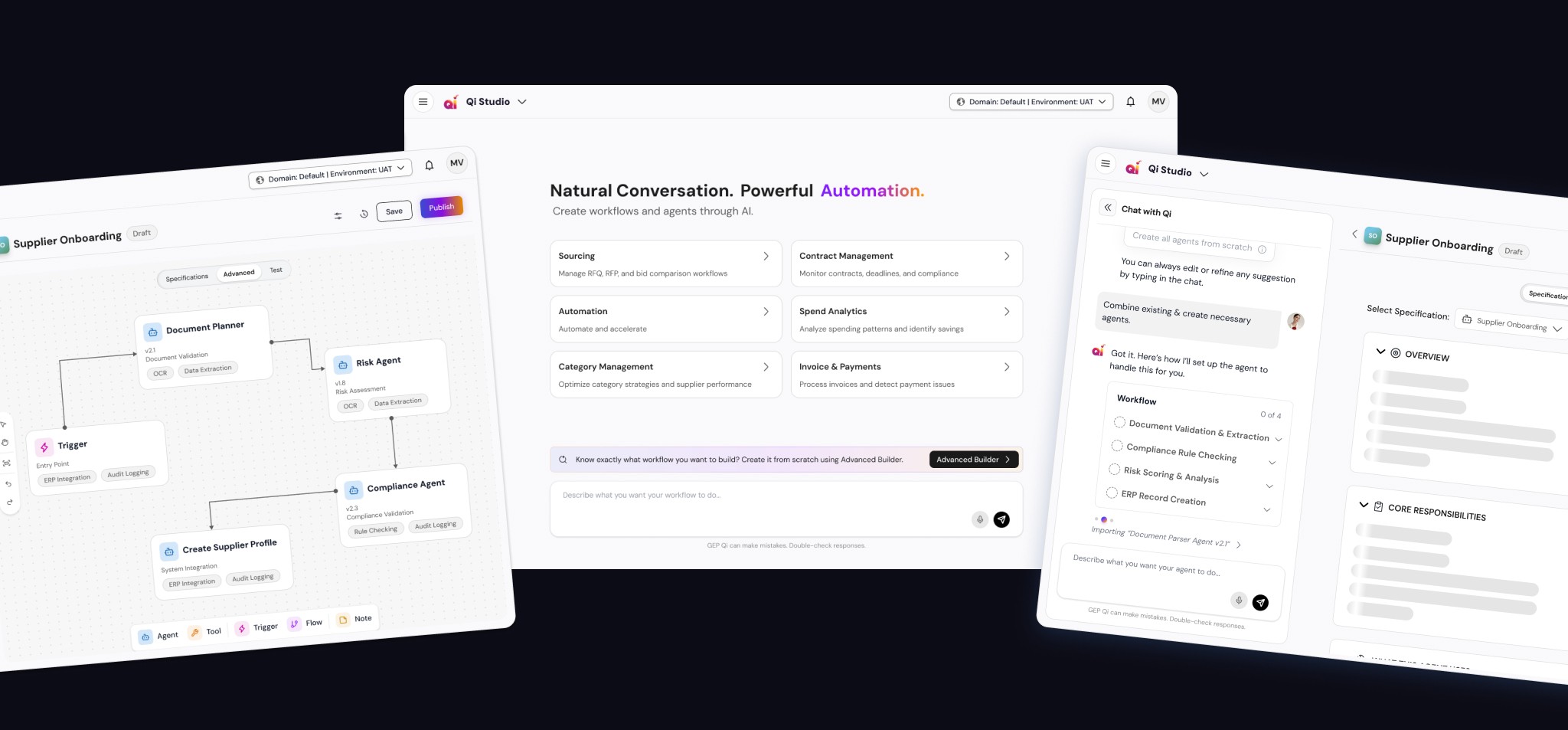
coverQi Studio — the advanced canvas, the home surface, and the specifications builder.
01 · overviewthe premise
The Sidekick Got Promoted.
Qi Studio is GEP's AI agent and workflow platform. It already worked for engineers.
The procurement experts who actually understood the workflows couldn't build them.
This is the story of how we redesigned the front door so the people who own the work
could finally do the work.
02 · roleco-lead ux
Both Sides of the Builder.
I co-led the UX for Qi Studio with another senior designer. Between us we held the IA,
the interaction patterns, the conversational design surface, the visual system, and the
design system tokens that hold the platform together.
My counterpart took the lead on the visual workflow canvas (Advanced mode). I took the
lead on the conversational surface (Specifications mode) and the cross-platform
interaction patterns. Most of the structural design — the dual-mode model, the primitive
taxonomy, the checkpoint system — was authored together.
We worked alongside ML and platform engineering (who owned the AI behaviour), product
management, and — most importantly — the procurement domain experts who became our
north star.
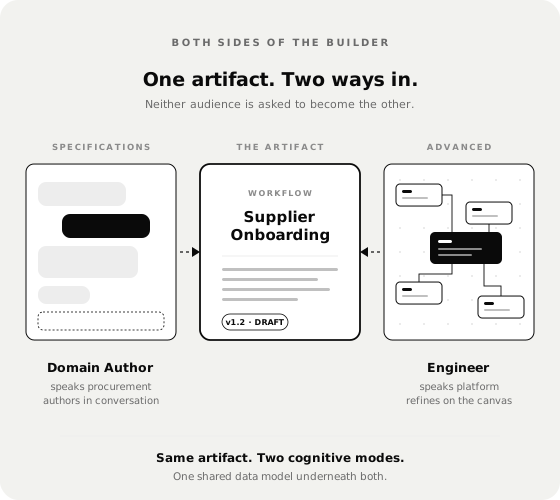
fig. 01Same artifact, two ways in — Specifications meets Advanced over one data model.
03 · key challenges04 problems
When the Builder is the Bottleneck.
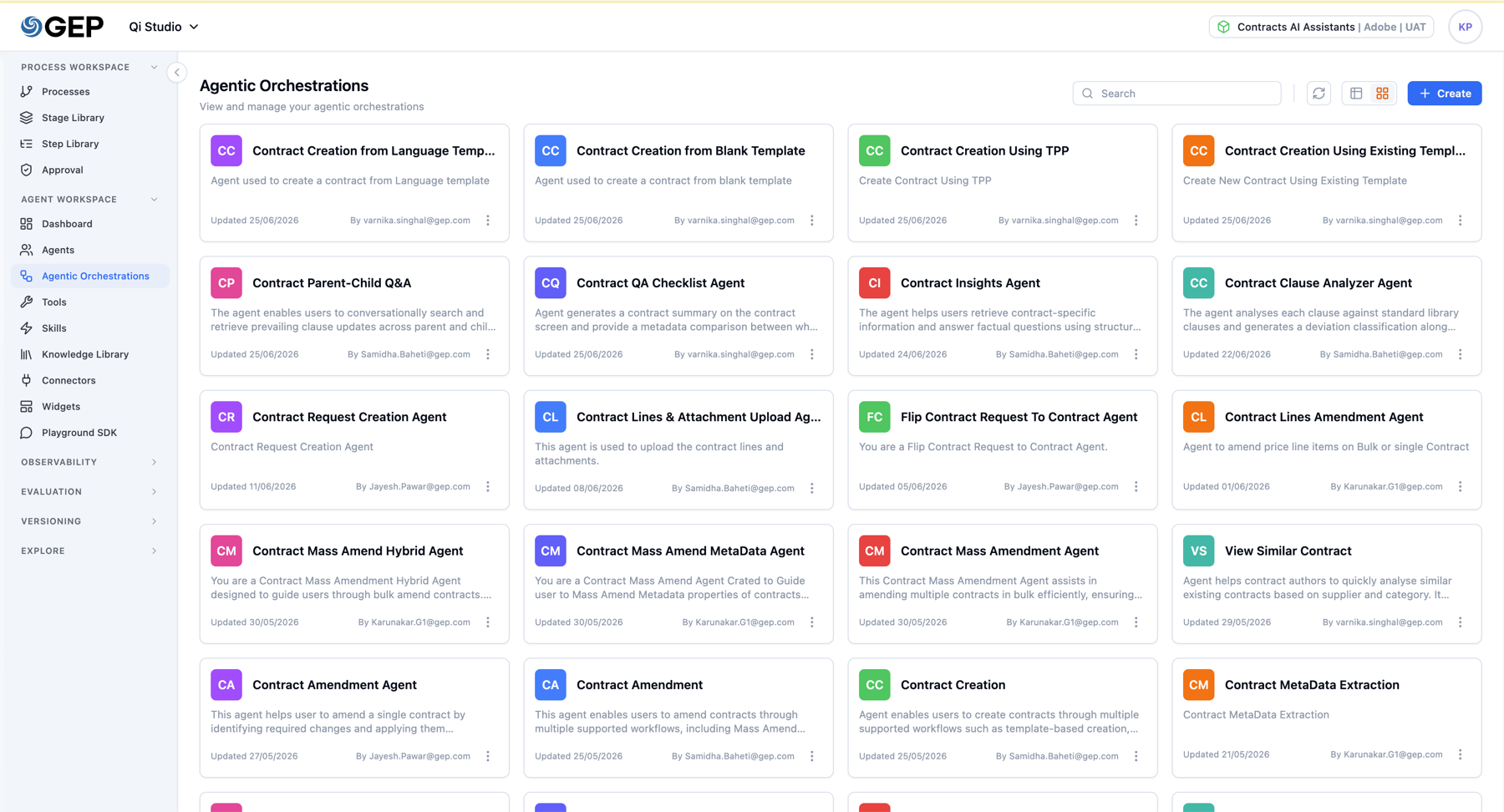
We weren't designing into a vacuum. Qi Studio already shipped — with two dozen
orchestrations, 151 connectors, a visual canvas, and a small purple AI helper called
QiPilot in the toolbar. The platform worked. It worked for the wrong audience.
challenge 01
The system spoke developer.
the pain
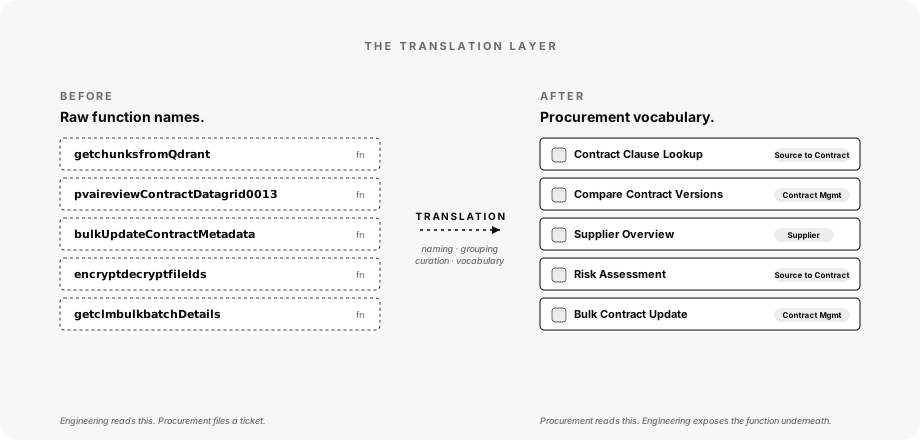
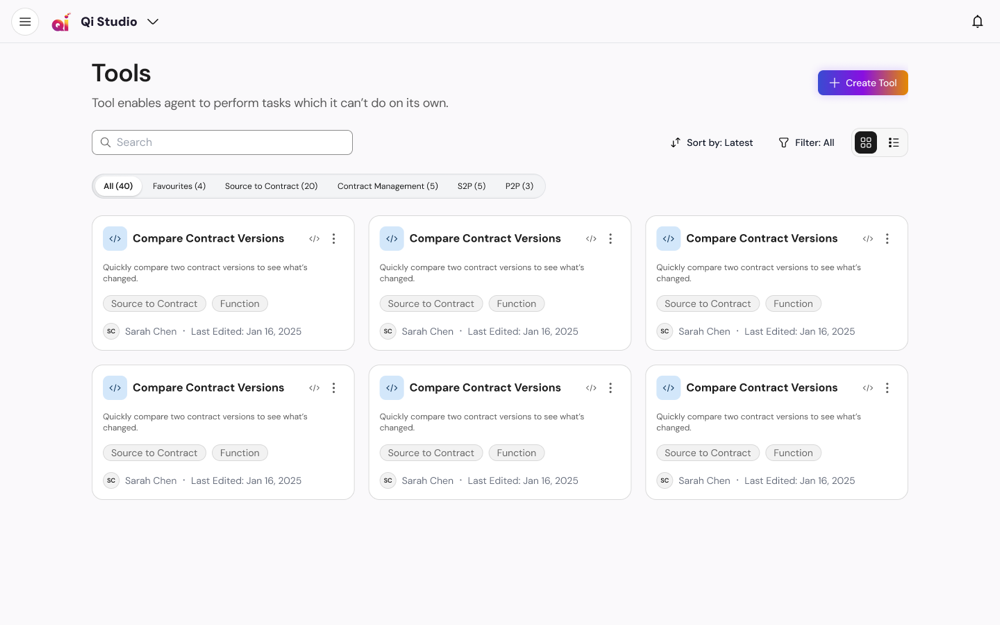
The tools catalogue was a wall of raw function names:
getchunksfromQdrant, pvaireviewContractDatagrid0013,
bulkUpdateContractMetadata. The IA was a developer's map. A sourcing
lead landing on this screen had no idea where to start.
the move
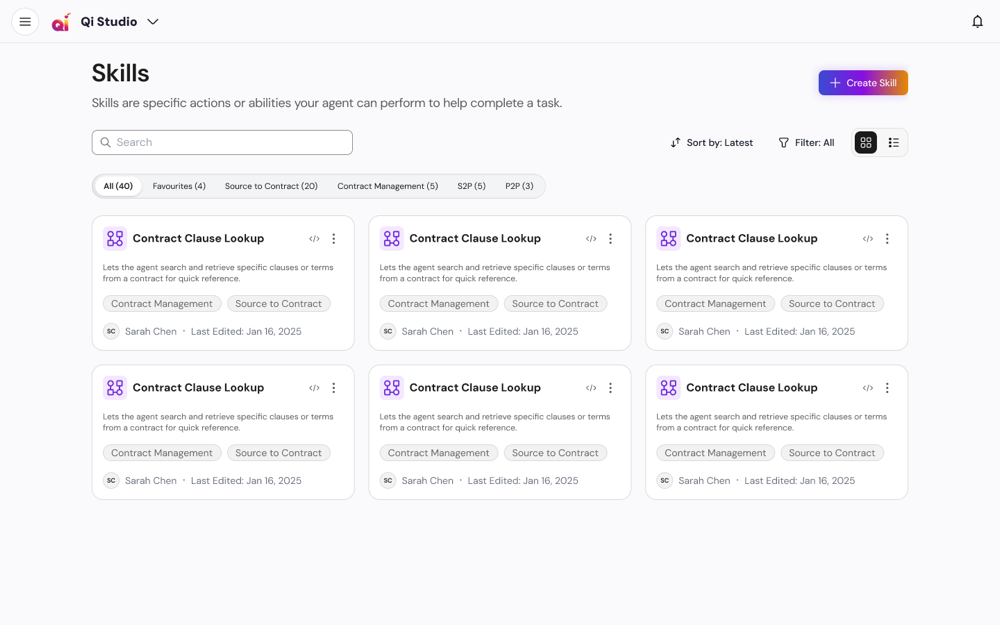
A translation layer. Tools, skills, knowledge, and connectors got
procurement-vernacular names (“Contract Clause Lookup”, “Compare Contract
Versions”) and short, plain-language descriptions. The IA collapsed from seven
workspaces to six clear primitives. The developer surface didn't disappear — it
moved one tab deeper.
fig. 02The translation layer — developer nomenclature to procurement vernacular.
challenge 02
Composition without curation.
the pain
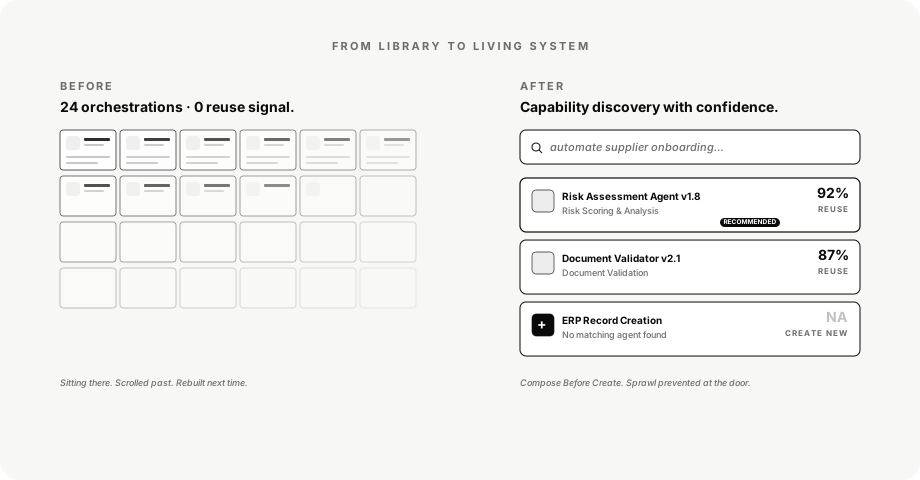
Twenty-four orchestrations already existed, hand-built one at a time. They sat in a
card library, scrolled past, and got rebuilt the next time someone asked for
something similar. No one was searching the library before building. There was no
shared memory.
the move
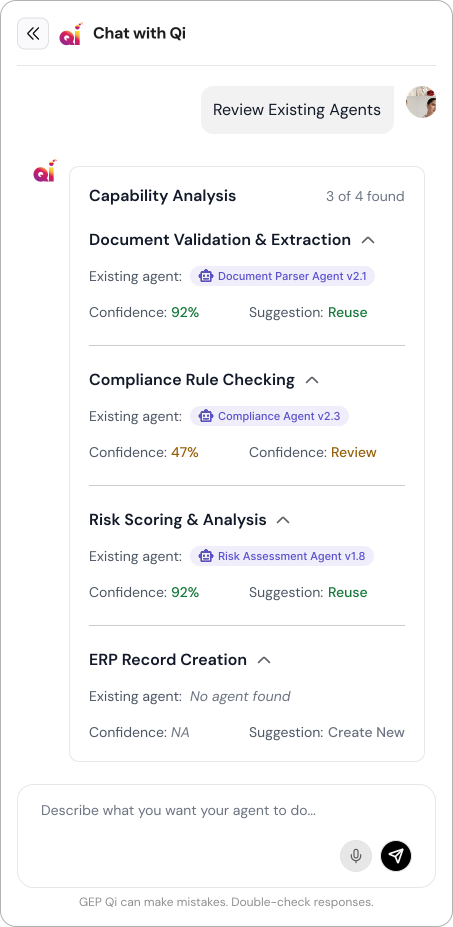
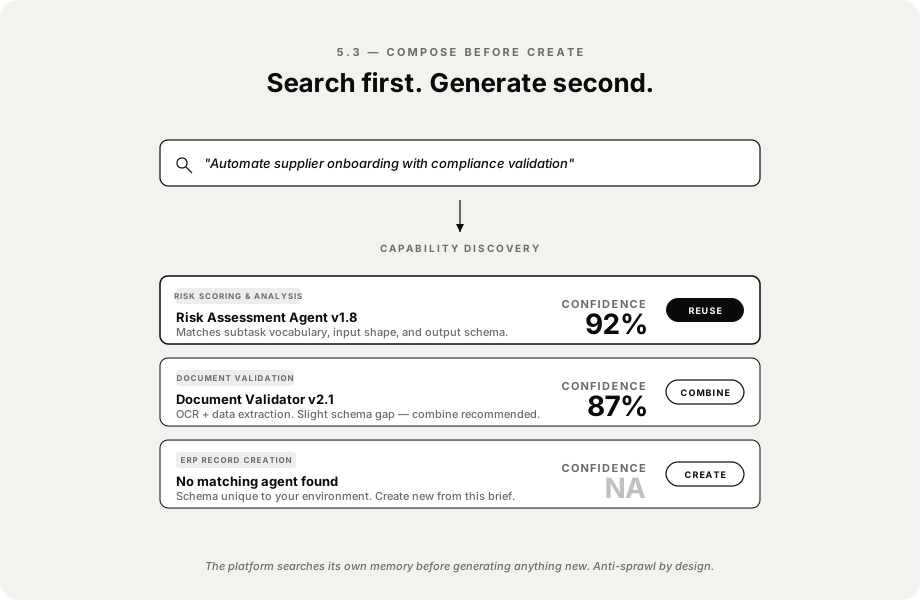
Capability discovery as the first move. When a user describes intent, Qi searches
the existing library and reports back with confidence scores. The default
recommended path: “Combine existing and create only what's missing.” We called it
Compose Before Create.
fig. 03Capability discovery — search the library before generating anything.
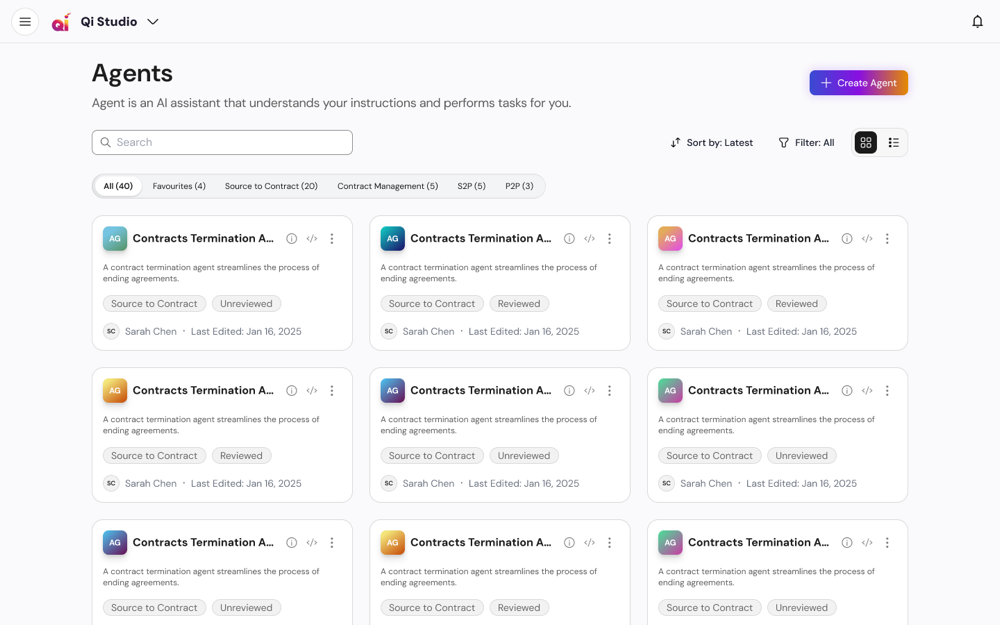
before
The catalogue as it shipped — two dozen agents in a card grid, scrolled past and
rebuilt the next time someone asked for something similar.
after
The same intent, answered before anything is generated: three of four capabilities
matched, each scored.
fig. 04The shipped catalogue, and the same intent answered by capability discovery.
challenge 03
The black-box problem.
the pain
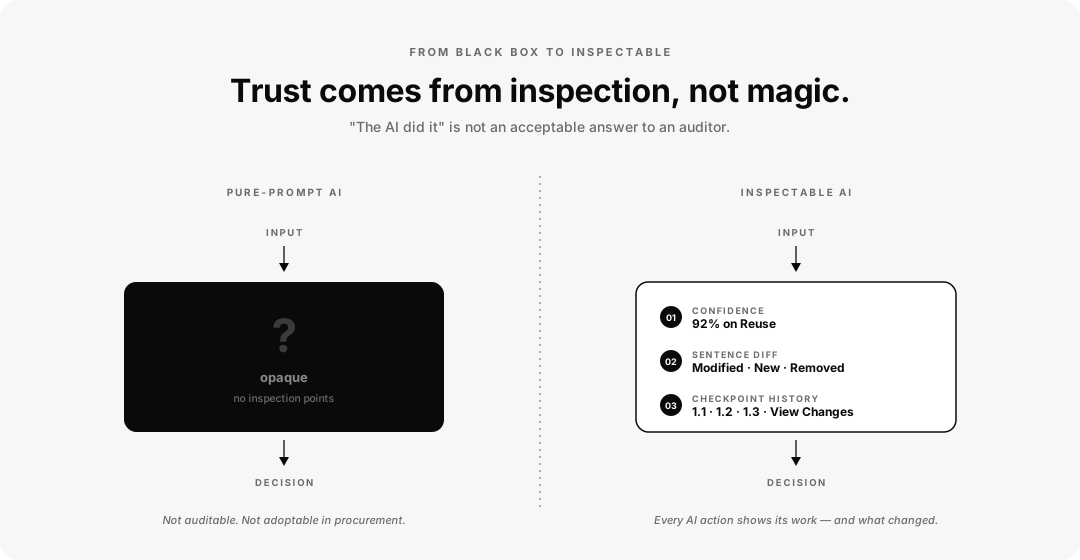
Enterprise procurement is a compliance-heavy domain. “The AI did it” is not an
acceptable answer when an auditor asks why a supplier was approved. Pure-prompt AI
tools are black boxes by default. Our users needed inspection, not magic.
the move
Every AI action shows its work. Confidence scores on reuse. Sentence-level diffs on
spec changes. Checkpoints at every step. The principle: a domain expert should
inspect what Qi did, why, and what changed — without learning to read code.
fig. 05Inspection over magic — every AI action shows its work.
challenge 04
Two audiences, one product.
the pain
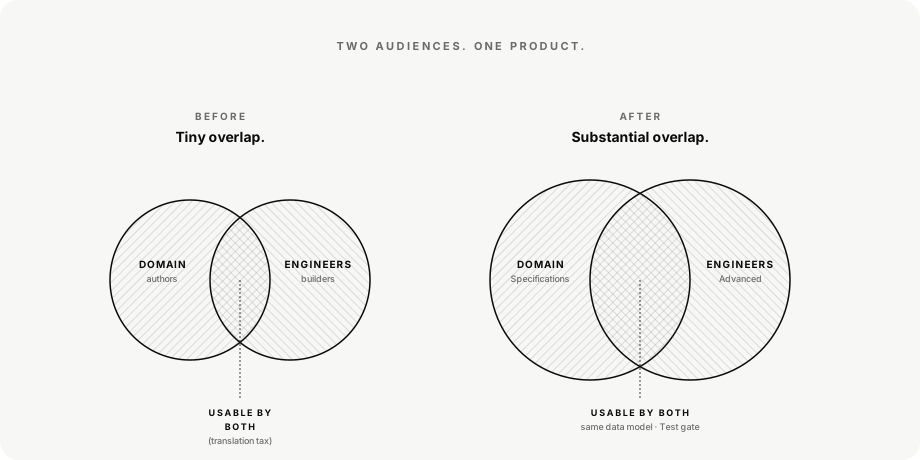
We couldn't remove the existing power surface. Engineering had built sophisticated
agents on the visual canvas — with state passing, ReAct strategies, custom tools,
model selection. They needed all of it. But every new feature shipped for
engineering pushed procurement further away.
the move
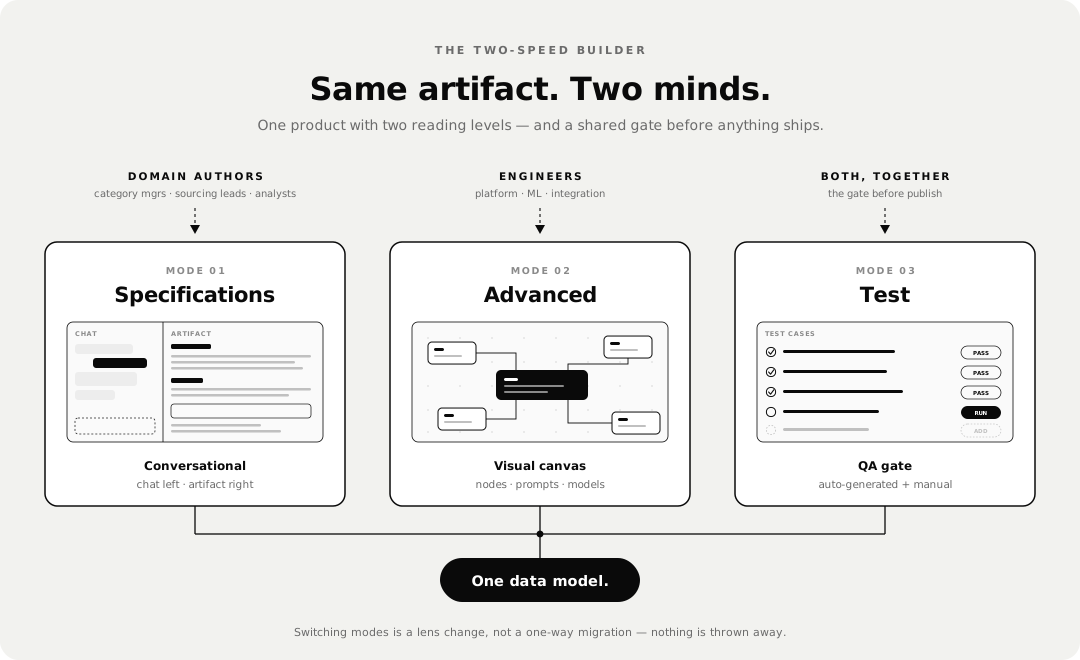
A two-speed builder. Same workflow, two cognitive modes. Specifications mode
(conversational, fast, domain-vernacular). Advanced mode (visual canvas, model
picker, system prompt editor). Test mode for QA. Not two products. One product,
two reading levels.
fig. 06One product, two reading levels — not two products.
framework
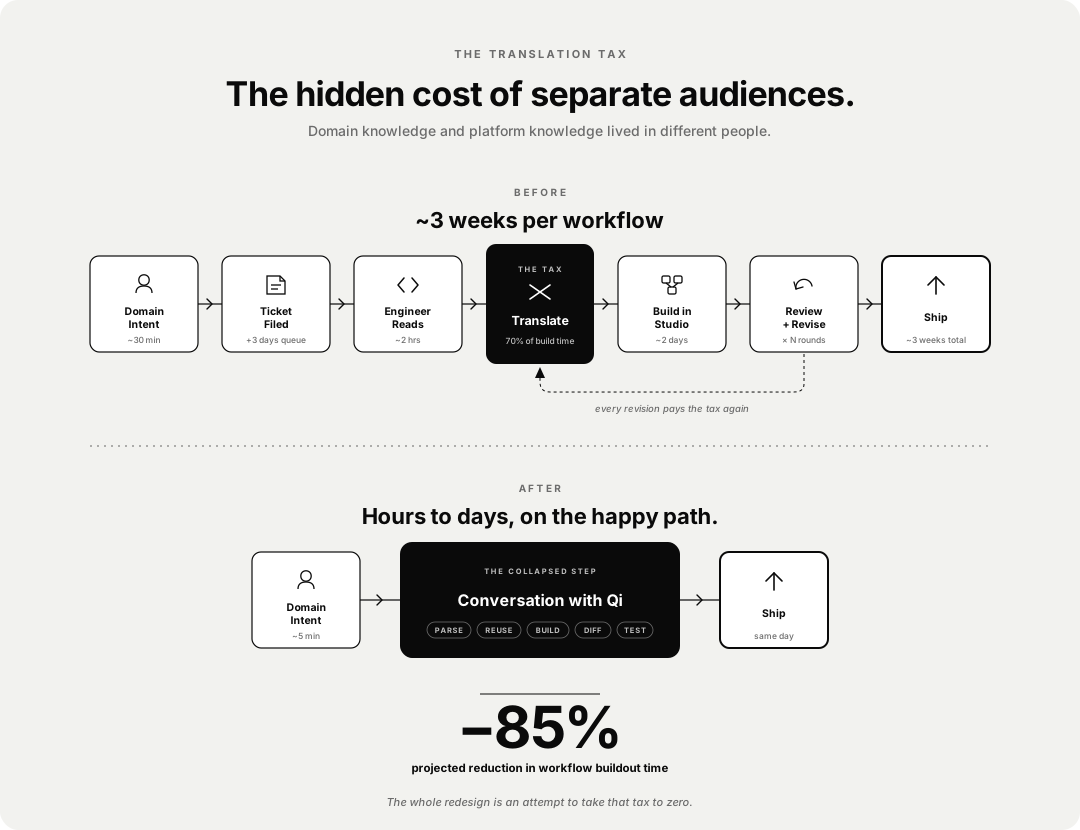
The Translation Tax
These four challenges aren't independent — they're symptoms of one structural cost.
Every time a procurement expert wanted to build a workflow, they paid a hidden tax:
explain it to engineering, wait, review, ask for changes, wait again. The whole
redesign is an attempt to take that tax to zero.
fig. 07The translation tax — before, after, and the step that collapses.
04 · process06 weeks research
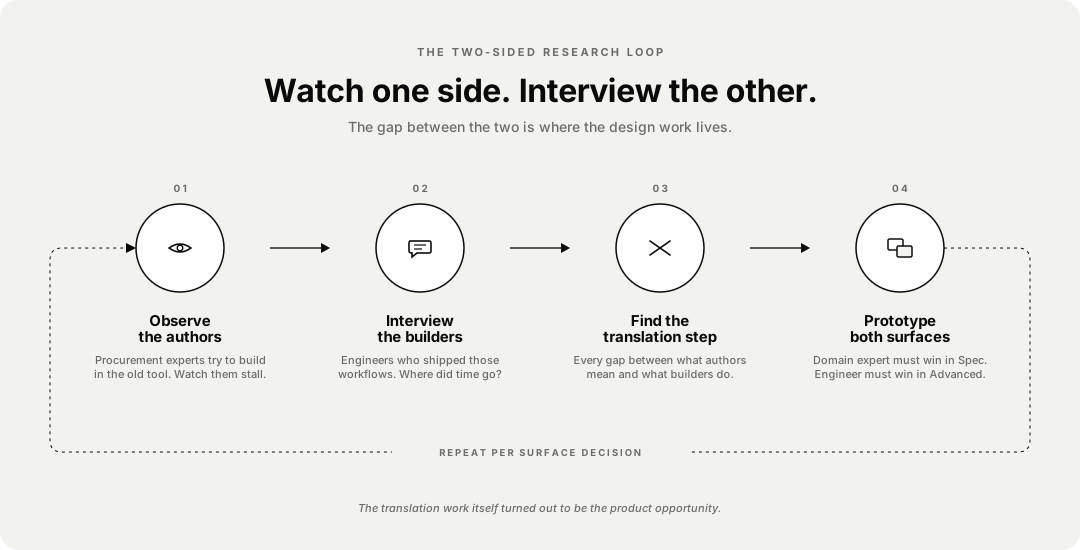
Listening Before Designing.
We didn't begin with sketches. We began with two parallel research tracks running for
six weeks — watching the experts struggle, and interviewing the engineers who had been
translating for them.
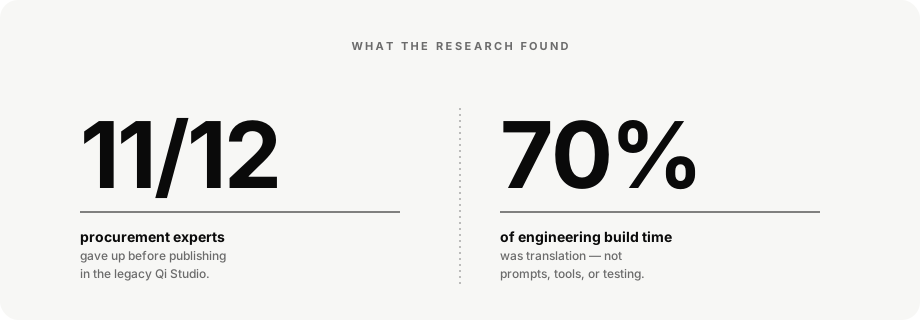
fig. 08What the research found — 11 of 12 authors stalled, and where the engineering time actually went.
fig. 09The two-sided research loop — observe one audience, interview the other, design the gap between them.
The procurement experts couldn't build. The engineers were spending most of their time
translating. The translation work itself was the product opportunity.
05 · ux design09 moves
Two Speeds, One Builder.
Five connected design moves — and one cross-platform pattern that ties them together.
Everything from here is the design response to The Translation Tax.
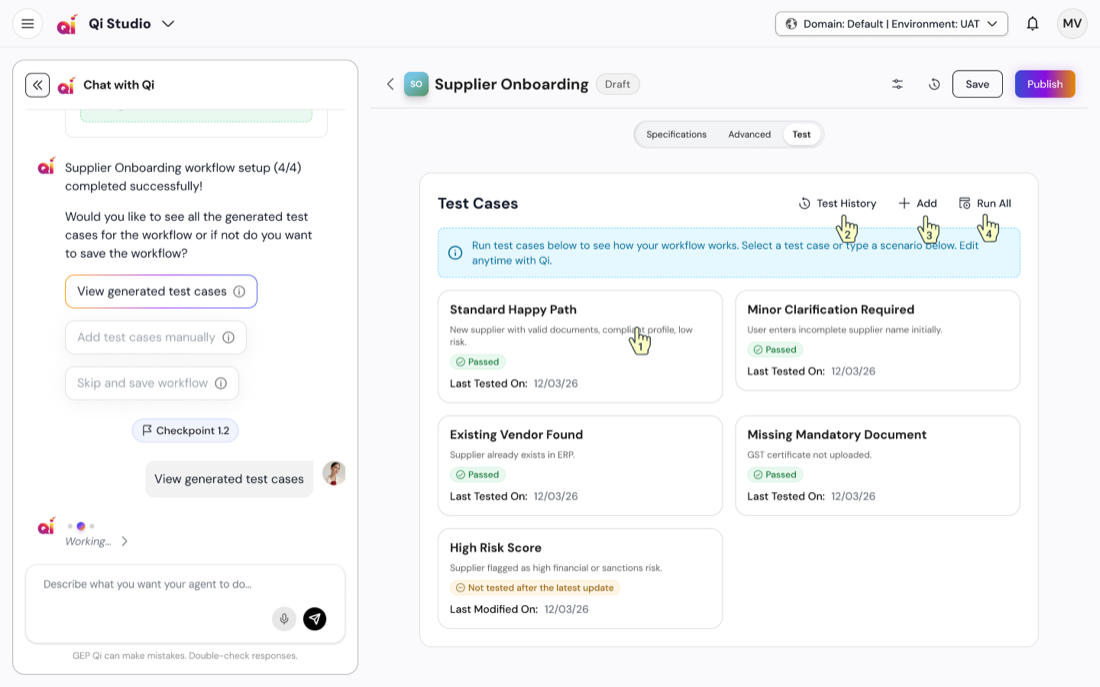
Same artifact. Two cognitive modes. One QA gate. Specifications is the new
procurement-friendly entry. Advanced is the existing developer canvas — preserved, not
replaced. Test is the gate where both audiences meet.
fig. 10The two-speed builder — one artifact, two cognitive modes, one QA gate.
mode 01 · specifications
mode 02 · advanced
mode 03 · test
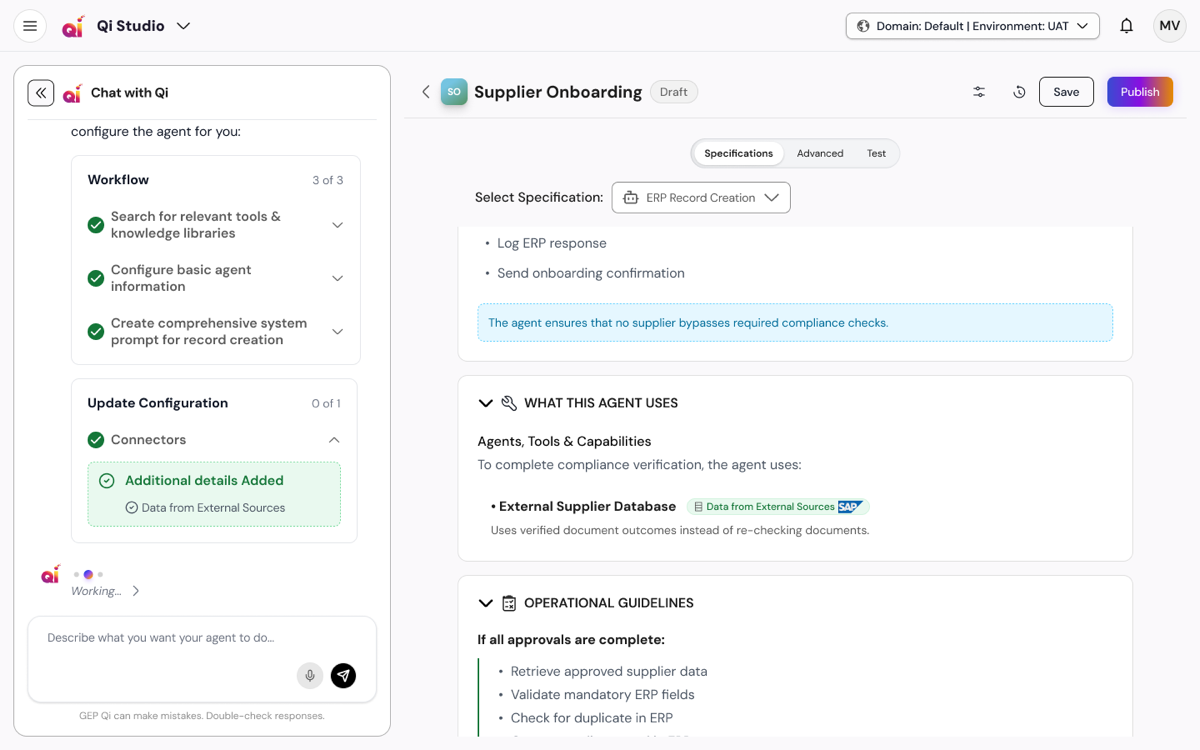
fig. 11The same Supplier Onboarding workflow, read at all three speeds.5.2 · pattern
The Conversation Pattern
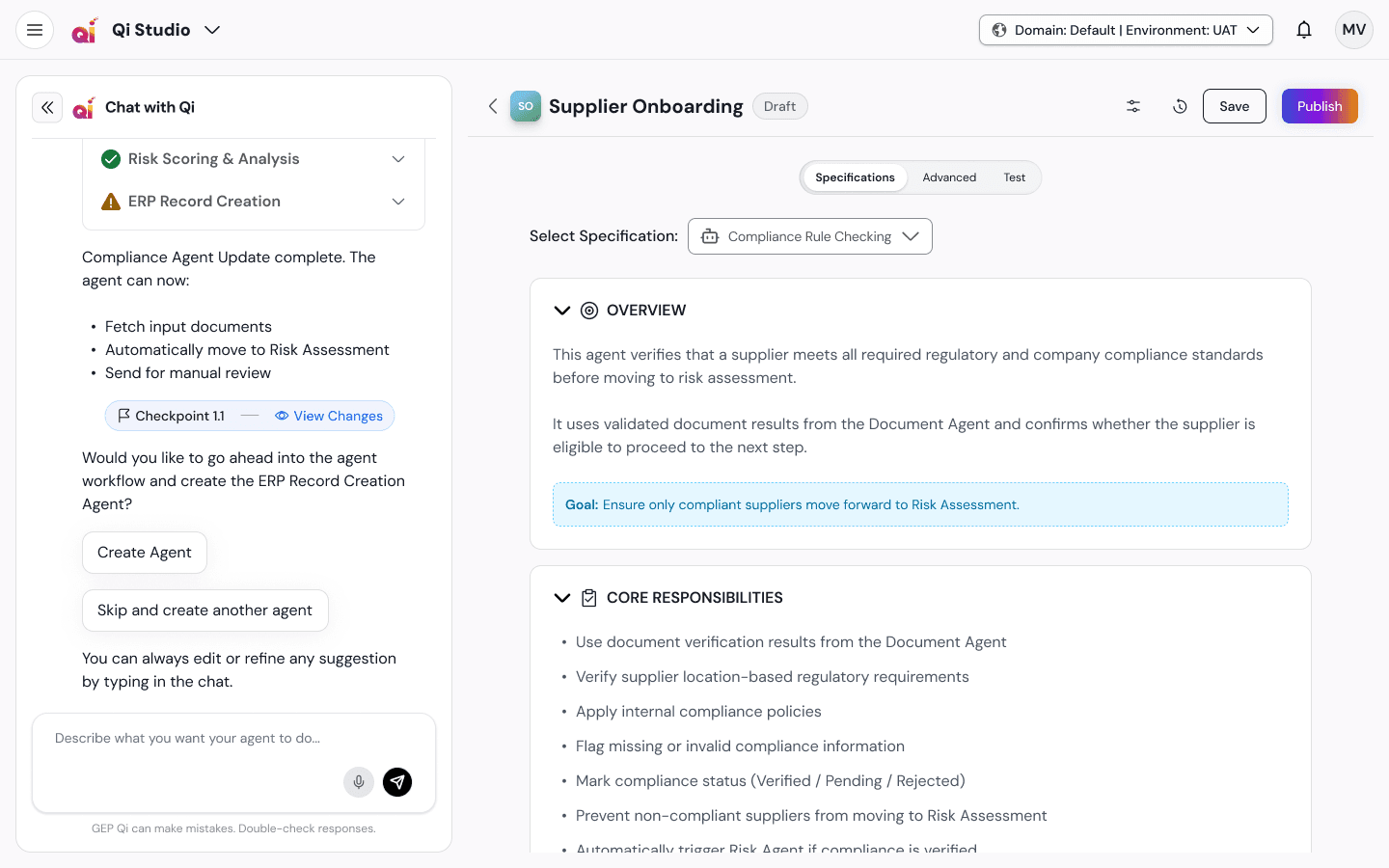
Chat on the left. Artifact on the right. Both live.
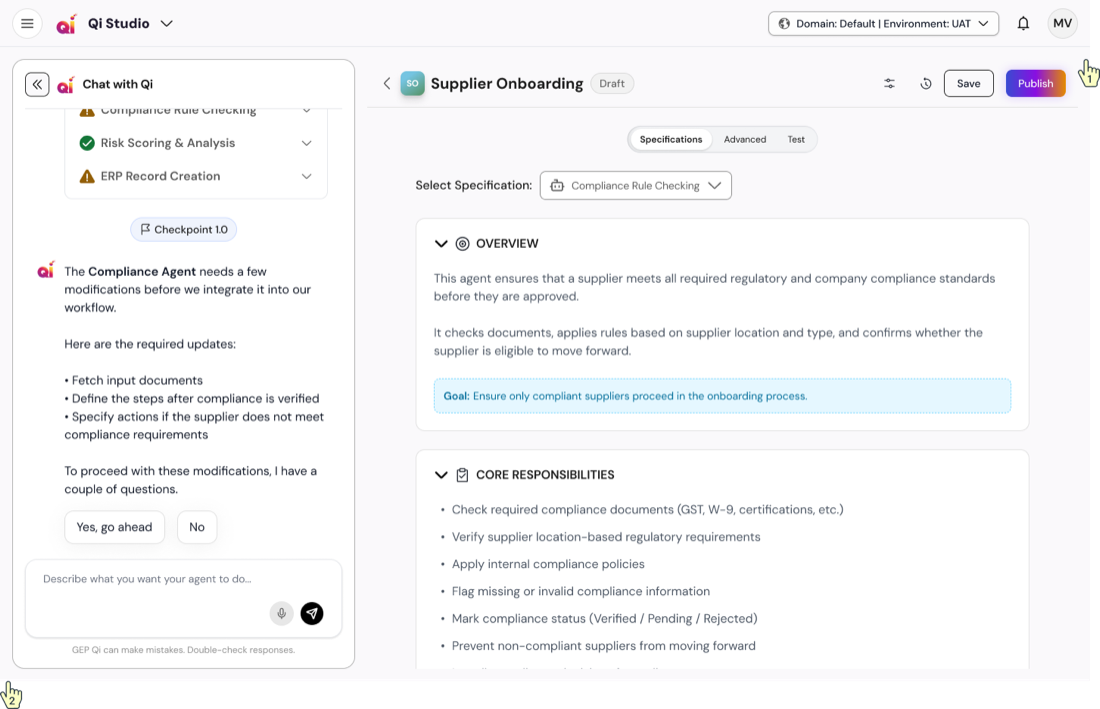
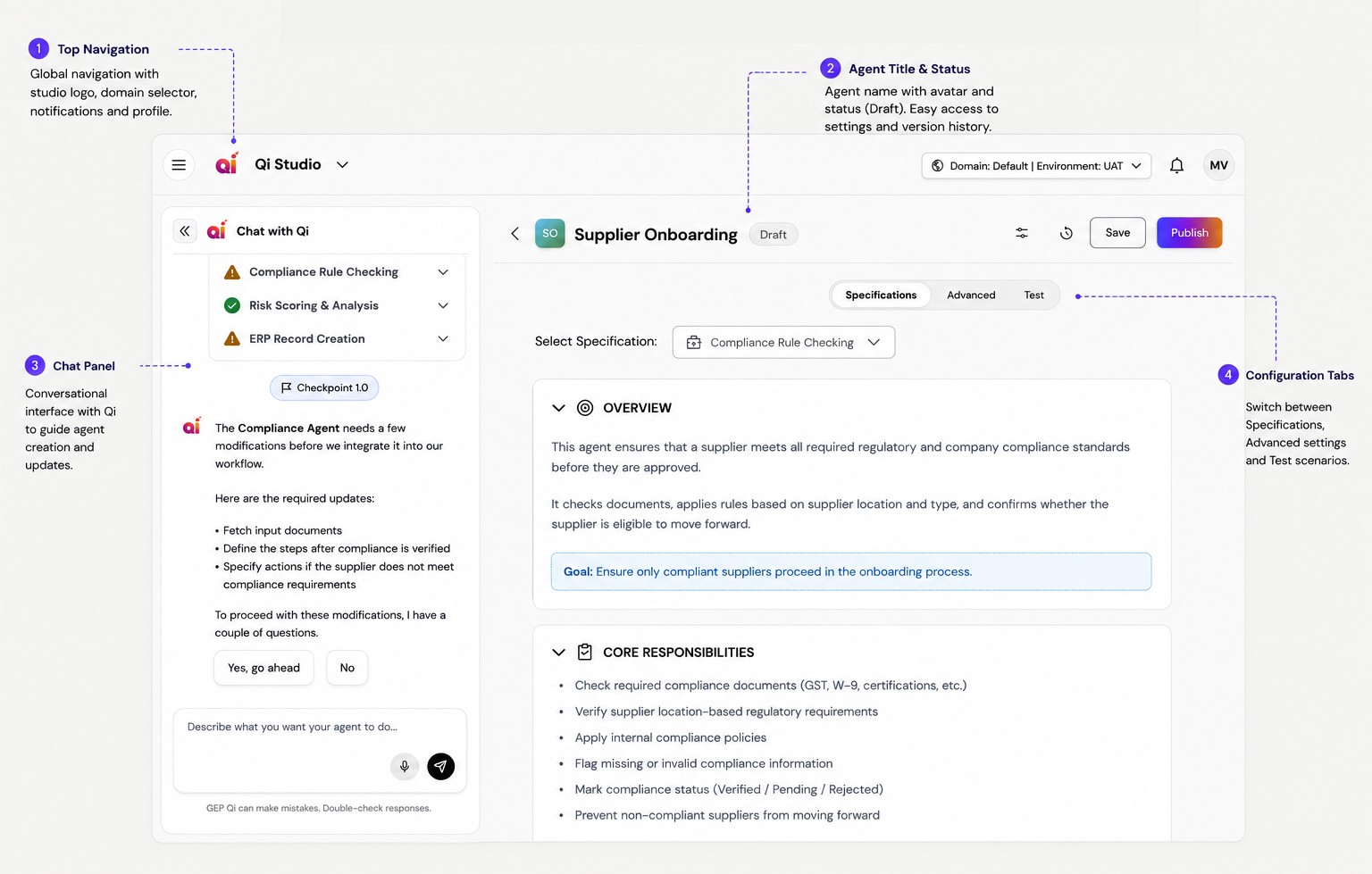
The Specifications surface is a two-pane layout that does something subtle: it makes
generative AI legible. The user watches the agent assemble in real time — Qi paraphrases
intent on the left, while sections of the spec stream into existence on the right.
Pure-chat AI tools hide the artifact in the conversation. Pure-builder tools strip away
the narration. The two-pane model gives users both.
Before Qi generates anything, it searches existing agents, skills, tools, and knowledge —
and returns reuse candidates with confidence scores. The Recommended path is always to
combine existing pieces with only what's net-new. Compose Before Create is the
anti-sprawl pattern expressed in the interaction itself.
the pattern
in the product
fig. 13Reuse candidates surfaced with confidence, before anything is generated — the pattern, and the panel that ships it.5.4 · trust mechanism
Checkpoint Architecture
Git, but for natural-language specs.
Versioning code is well-understood. Versioning natural-language agent specifications —
where a single sentence can change behaviour — is not. Every meaningful step in the build
flow generates a Checkpoint with a View Changes affordance. Opening it shows
sentence-level diffs: Modified, New, Removed. Read like an email amendment, not a code
commit.
fig. 14Checkpoints in the build flow, each with a View Changes affordance.5.5 · trust mechanism
Build-Time Honesty
Surface every gap during construction.
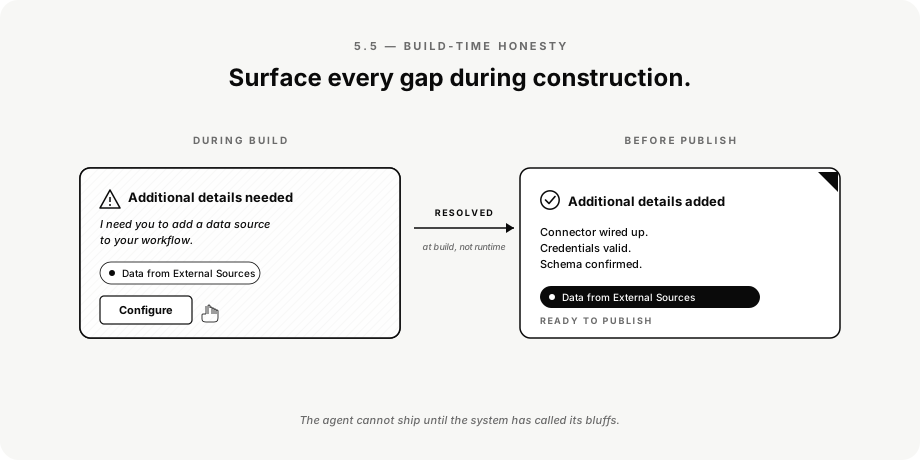
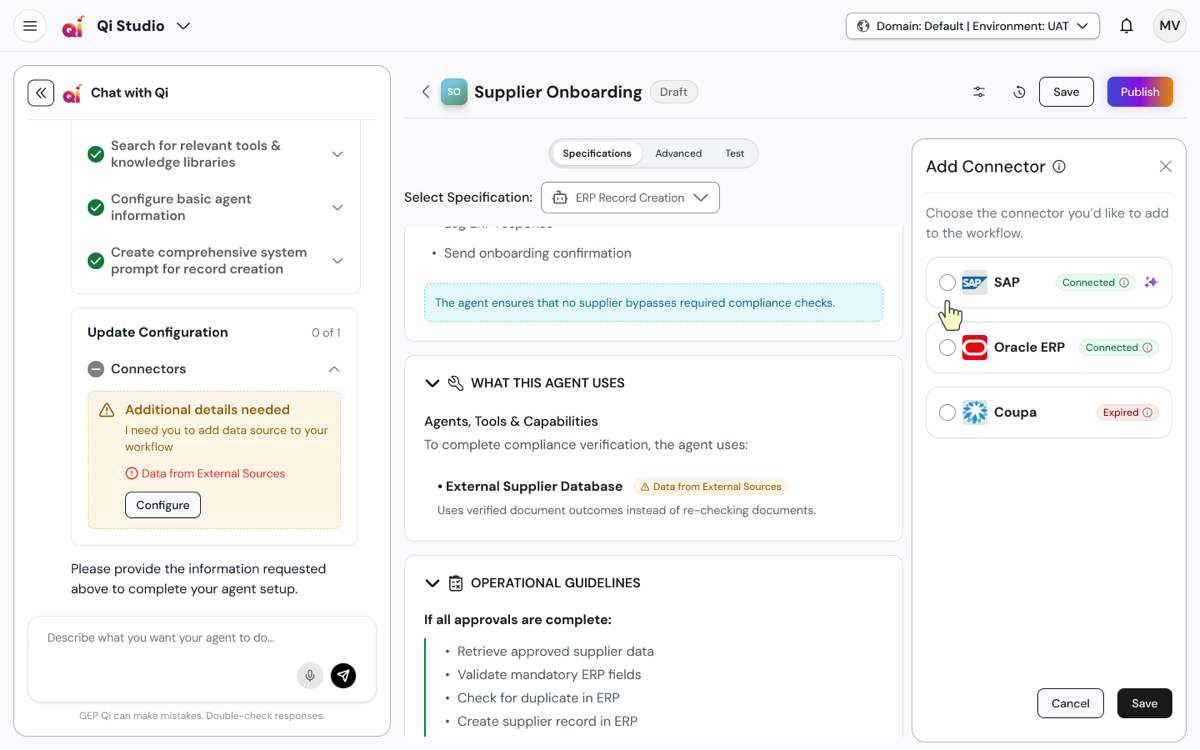
The old Qi Studio would let you save an unconfigured orchestration and find out at
runtime that a connector was missing. The redesign surfaces every structural gap during
build — missing connectors, ambiguous inputs, untested edges — with inline warnings and
Configure CTAs. The agent cannot ship until the system has called its bluffs.
fig. 15Structural gaps surfaced at build time, not at runtime.
during build
before publish
fig. 16The same gap, called at build time and cleared before publish.5.6 · architecture
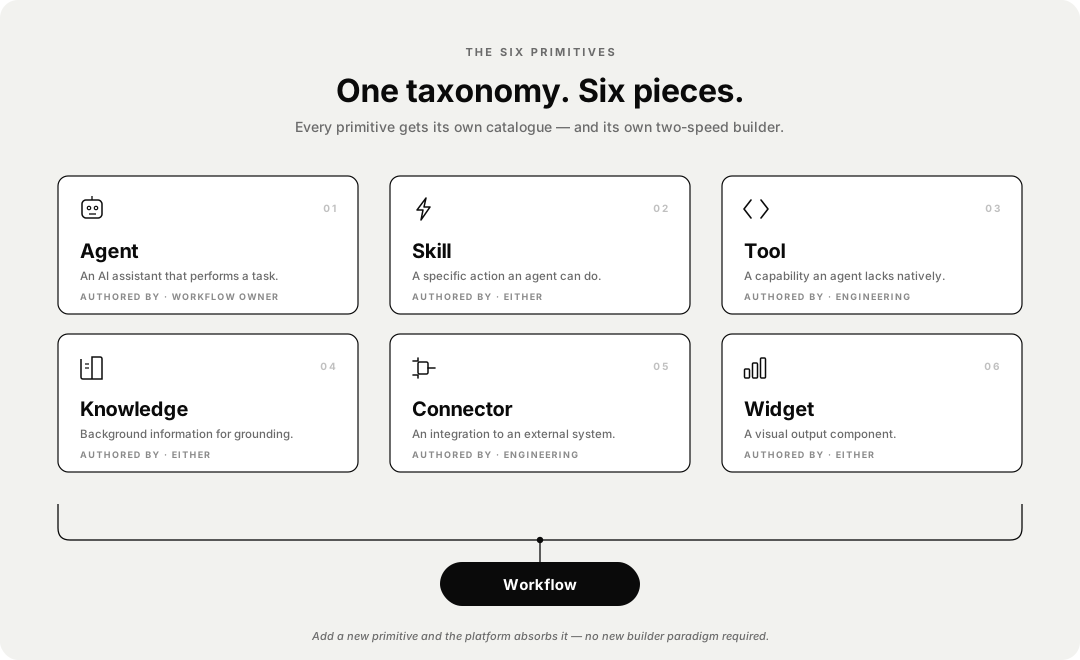
The Six Primitives
One taxonomy. Six pieces. Many workflows.
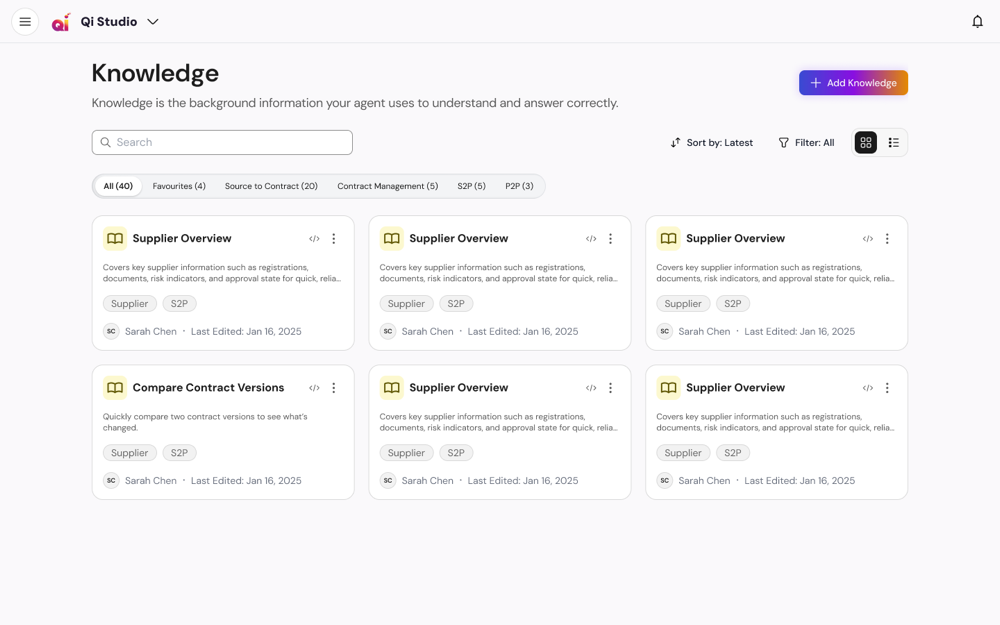
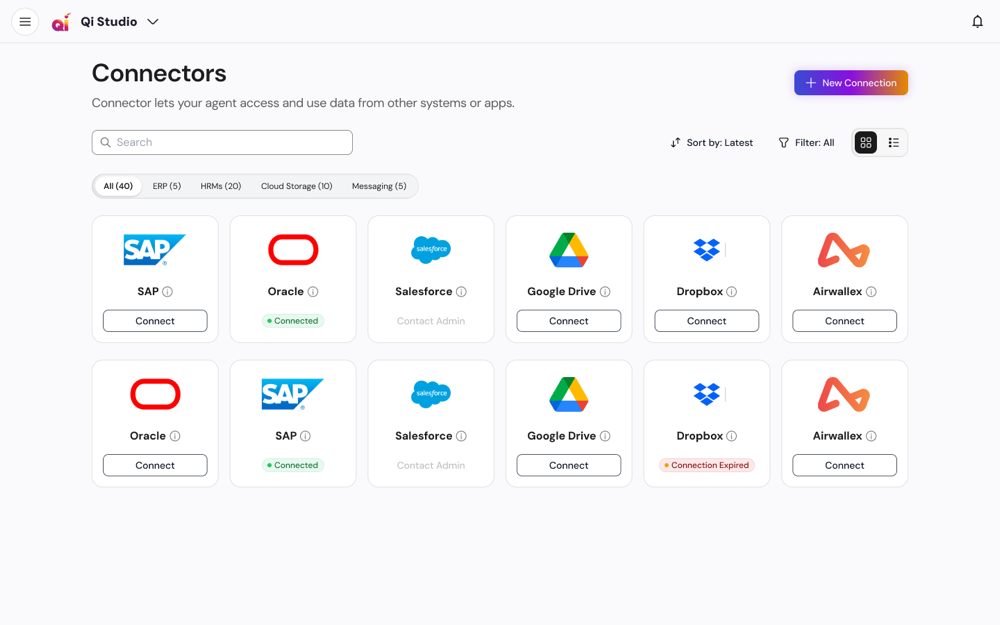
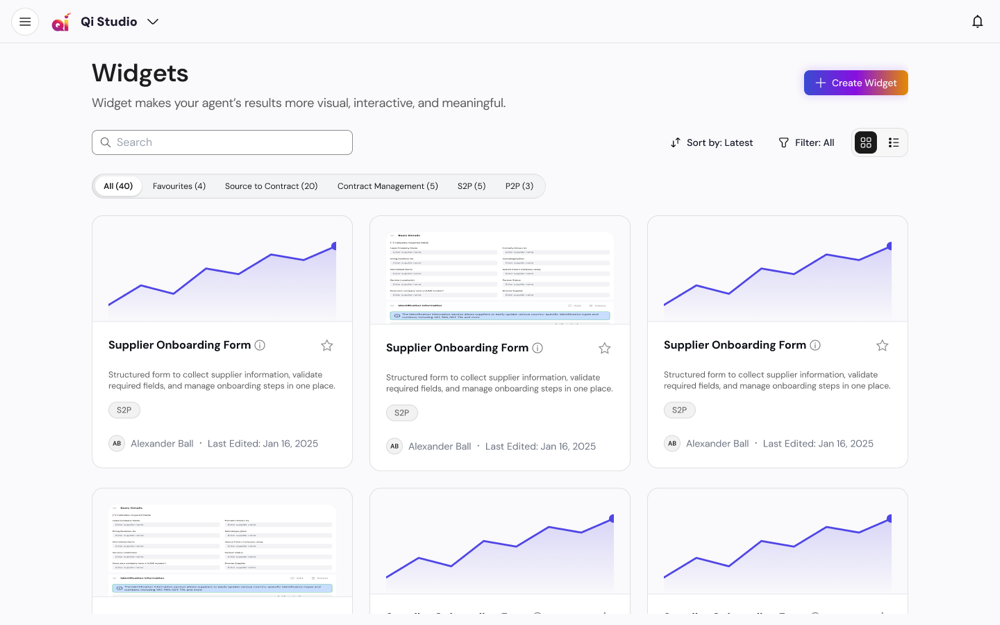
Underneath every authoring surface is a single architectural taxonomy. Agents are made
of Skills. Skills use Tools and Knowledge. Tools and Connectors talk to data. Widgets
surface results. Each primitive gets its own catalogue page, its own
procurement-vernacular naming, and — critically — its own two-speed builder.
fig. 17The primitive taxonomy underneath every authoring surface.
01 · agent
02 · skill
03 · tool
04 · knowledge
05 · connector
06 · widget
fig. 18One catalogue per primitive — the same page grammar six times over.5.7 · platform pattern
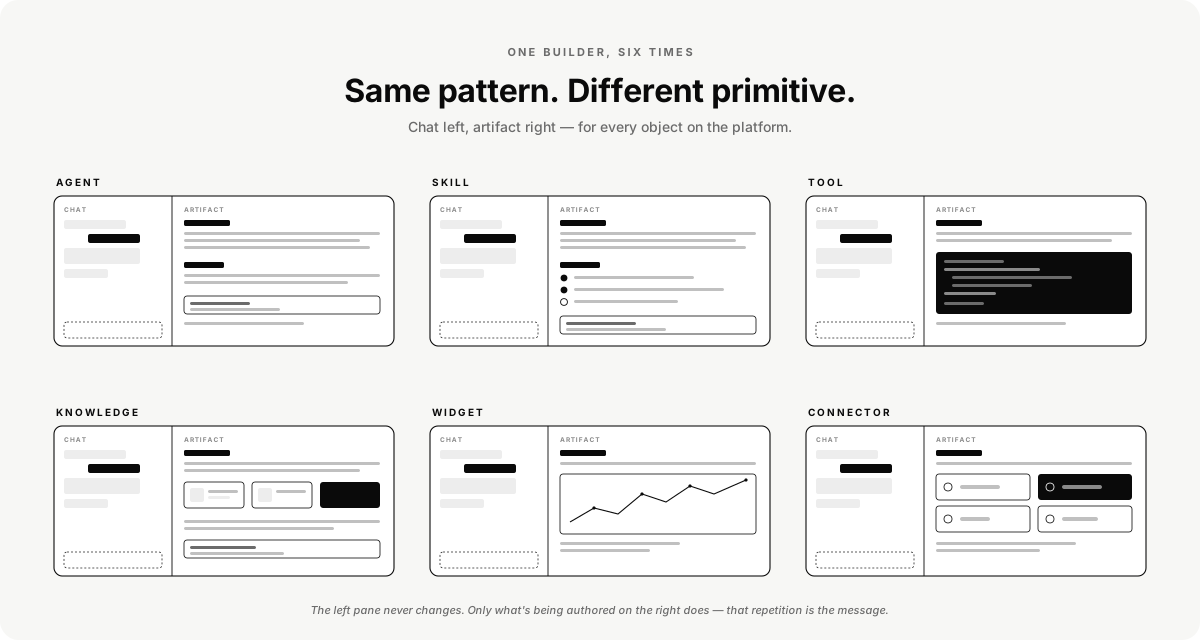
One Builder, Six Times.
Same pattern. Different primitive.
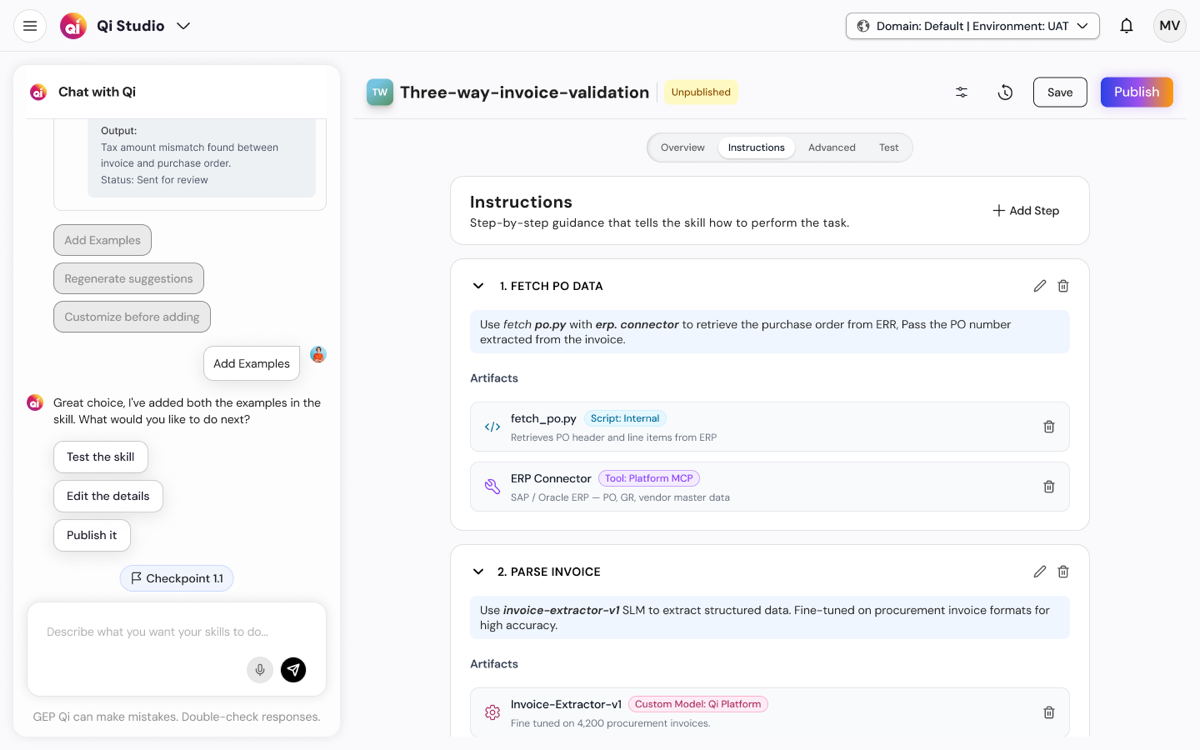
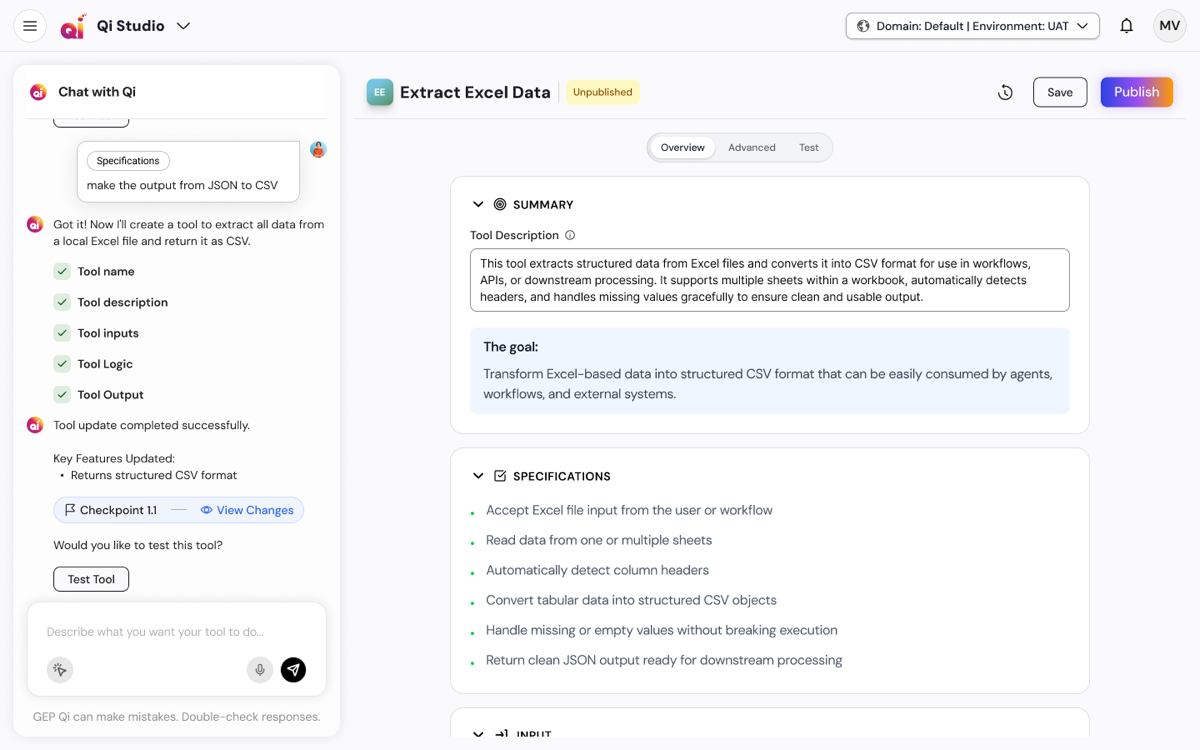
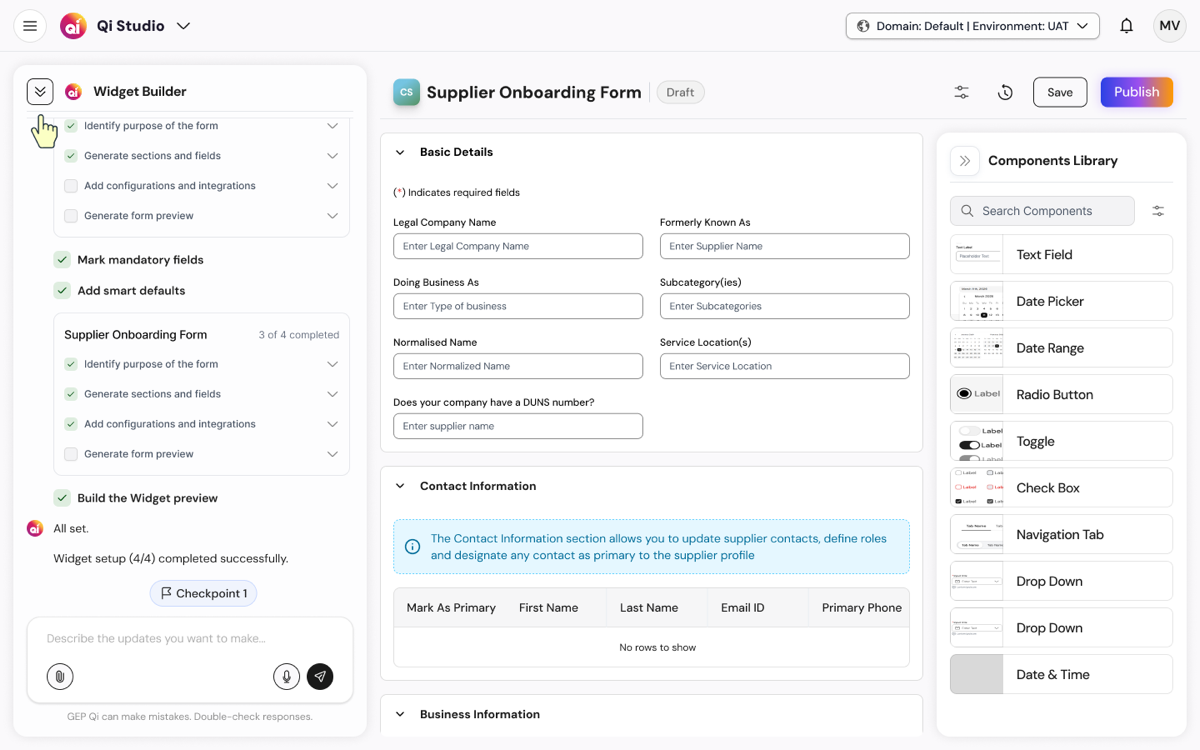
The Specifications surface authors agents, skills, tools, knowledge, widgets, and
connectors — every primitive — with the same chat-left, artifact-right composition. The
grammar is the platform. Add a new primitive type in the future and the platform absorbs
it without a new builder paradigm.
fig. 19The same composition, applied across every primitive type.
agent
skill
tool
widget
fig. 20Chat left, artifact right — the same builder authoring four different primitives.5.8 · power surface
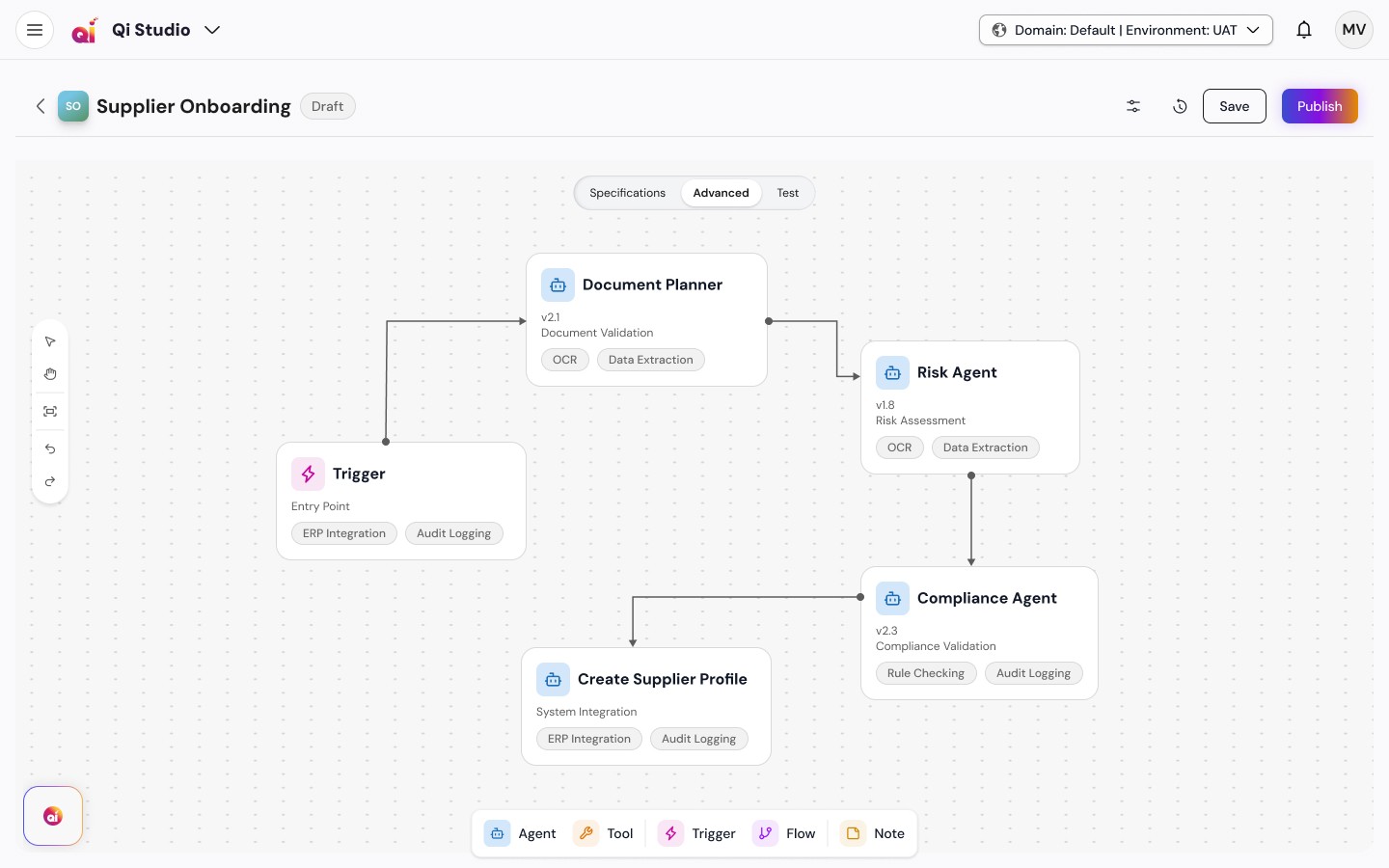
The Advanced Canvas, Preserved.
Engineers didn't lose their tool.
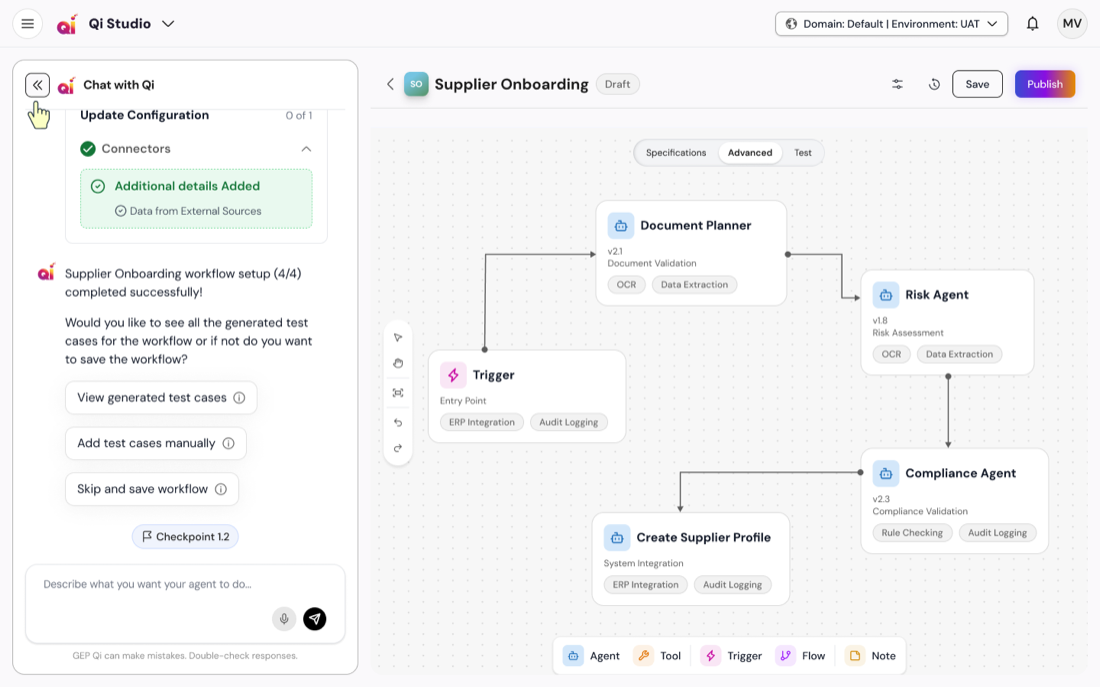
The Advanced canvas is the original Qi Studio orchestration editor — refined but intact.
Node-and-wire workflow on a dotted grid. Per-agent versioning (v2.1, v1.8, v2.3). Model
picker exposed. System prompt editor with markdown, state references, and ReAct strategy
selection. Anything authored in Specifications opens cleanly here. No conversion. No
data loss.
fig. 21The original orchestration editor — refined, not replaced.5.9 · system
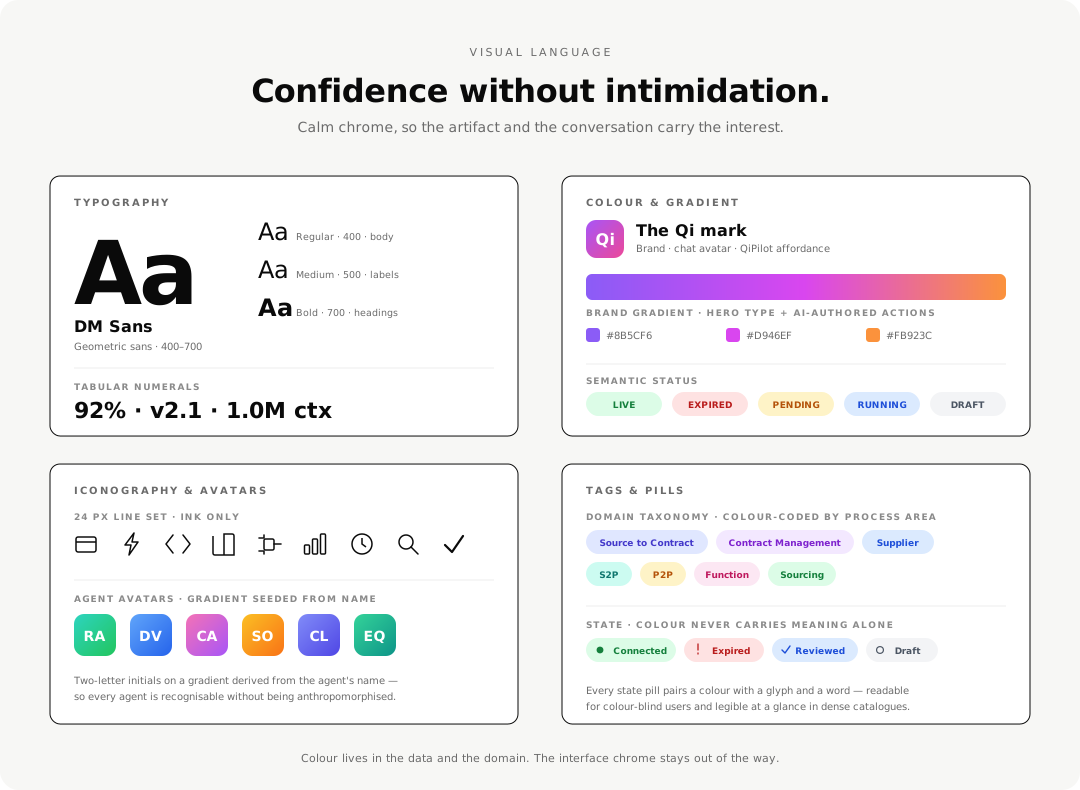
Confidence without intimidation.
Legibility before personality.
We anchored the visual system on legibility before personality. The result is
intentionally calm. The interesting things happen in the artifact pane and the chat —
the chrome stays out of the way. Typography, status colors, iconography, tags, pills,
and multilingual scaffolding all serve one goal: help procurement experts inspect what
Qi is doing without making the product feel technical or intimidating.
fig. 22The system sheet — type, colour, iconography, avatars, tags and state.
06 · closingrolling out
Still Iterating, Already Adopted.
The redesign is rolling out in waves across GEP's customer environments. We don't have a
full quarter of measured outcome data yet — but the early signal is qualitative,
observable, and consistent.
I used to file a ticket and wait three weeks. Now I describe what I want and watch the
agent appear on the right. The first time it surfaced an existing agent I didn't know we
had, I felt like the platform had finally caught up to me.
Category Manager · Internal Pilot
What's working.
working — 01
Procurement authors are completing workflows end-to-end.
Without engineering hand-off, in early pilots. The translation step is collapsing
exactly where the research predicted.
working — 02
Engineers haven't lost their canvas.
Adoption of Advanced mode is unchanged among the engineering audience. The two-speed
model didn't force a migration — it added a lane.
working — 03
The reuse rate is climbing.
The 24 legacy orchestrations were rebuilt from scratch in 80% of new requests. Early
pilots suggest Compose Before Create is meaningfully bending that curve.
Projected impact.
Framed against industry benchmarks — targets, not measured results.
workflow buildout2–8 wk → hrs
Industry benchmark for procurement IT-led workflow buildouts. Target with
conversational authoring: hours to days on the happy path.
onboarding curve40+ hrs → 2
Enterprise no-code AI platforms typically need 40+ hours of training. Targeting under
2 hours through native procurement vocabulary.
reuse rate20% → 60%+
Legacy baseline was approx 20% reuse on new requests. Compose Before Create targets
60%+ within the first year of rollout.
Winning moments.
01
The promotion of the sidekick.
The single design move that organised everything else. Reframing QiPilot from a
toolbar button to the primary surface unlocked the rest of the system.
02
Preserved engineering trust.
The hardest stakeholder wasn't procurement — it was the engineering team who built the
original canvas. Designing with them kept their work load-bearing in the new platform.
03
One builder, six times.
The conversational + canvas pattern scaled across every primitive type with no
architectural rework. The grammar was right.
04
The diff view earned its keep.
Watching a domain expert review a checkpoint diff and catch a regression was the
moment the system felt trustable.
Lessons learned.
01
Don't redesign what works. Redesign what shipped to the wrong audience.
The brief was almost never to add capability — it was to widen access without breaking
the existing audience.
02
Two-audience products need two-audience research.
The translation step between procurement and engineering was invisible until we
interviewed both sides in parallel.
03
Conversation alone isn't trust.
Trust comes from inspection — confidence scores, diffs, checkpoints, build-time
warnings. The conversation is the entry; the artifact is the contract.
04
Naming is the most under-estimated design work in AI platforms.
Renaming getchunksfromQdrant to “Contract Clause Lookup” is the difference
between a tool a procurement person adopts and one they file a ticket about.